
Thai Property Ownership and Long-Term Visas: What You Need to Know
Buying property in Thailand is a popular investment, but a common myth is that property ownership automatically grants you a residency visa. In this comprehensive guide, we clear up the facts about Thai property ownership, explain how your visa status is determined independently by factors like age and finances, and break down the best long-term visa options available—from Elite and LTR visas to Retirement, Business, and Destination Thailand Visas (DTV).

Does Real Estate Ownership in Thailand give me a Visa?
Find out more about long-term visas and the Thailand Privilege (Elite) Visa Programs (5, 10 & 15 Years)
Let’s clear up a big myth straight away: owning Thai property doesn’t automatically get you a visa—no matter what stories you might’ve heard. Getting a visa depends on your personal situation—your age, finances, marital status, job, or other factors. It’s not as simple as just buying a house and thinking you’re set.
The good news is there are several visa options for foreigners, based on how long you want to stay. At My Pattaya Real Estate Co., Ltd., we’re always happy to connect you with a qualified, independent visa specialist for a free first consultation, though after that, regular fees apply.
It’s essential to keep your Thai visa valid—and to always know its expiry date. Overstaying isn’t something Thai immigration takes lightly. You’ll get fined depending on how long you overstay, and in worse cases can lead to arrest, detention, deportation, or even a ban from coming back for years. Take expiry dates seriously; renew or leave on time to stay on the right side of the rules.
Short-term Visa Options (14–90 Days)
1. Bilateral Visa Exemption Agreement – 14 Days (Air Arrivals Only): Travelers from Cambodia and Myanmar (from July 14, 2026 onward) can visit for up to 14 days without an advance visa application. No age limits—including minors—but everyone needs a valid, undamaged passport with at least 6 months left, a blank page for stamps, proof of onward or return travel, and an address in Thailand. If kids are traveling alone or with one parent, birth certificates or parental consent letters might be required. This visa can’t be extended for tourist stays—you won’t get a 30-day extension. In emergencies, you might get a seven-day extension to leave the country for 1,900 THB.
2. Visa on Arrival (VOA) – 15 Days: Holders from Azerbaijan, Belarus, and Serbia (from July 14, 2026 onward) qualify for 15 days in Thailand for tourism, no advance visa needed. All standard entry rules apply—passport, ticket out, accommodation, and possibly extra documents for minors. This visa isn’t extendable for longer stays. Again, they may let you buy a seven-day extension for emergencies.
3. Visa Exemption (VE) – 15 Days: Passport holders from Mauritius and Seychelles (from July 14, 2026 onward) can come for up to 15 days with no advance visa. Rules are identical—good passport, ticket, accommodation proof, minors may need extra papers, and no extension for long-stay tourism. Only emergency extensions for seven days are possible.
4. Bilateral Visa Exemption Agreements – 30 Days: If you’re from China, Hong Kong, Kazakhstan, Laos, Macau, Mongolia, Russia, Timor-Leste, or Vietnam, you can visit for 30 days, no prior visa required—even minors. All basic requirements still apply. Everyone (except those from Laos) can typically extend once by 30 days for 1,900 THB at a local immigration office, bringing your stay up to 60 days.
5. Visa Exemption – 30 Days (VE): Passport holders from Australia, Austria, Bahrain, Belgium, and many others (see the list) qualify for 30 days without a visa, including minors. Standard requirements apply. You can usually extend these visas once for 30 days, for 1,900 THB, totaling 60 days.
6. Bilateral Visa Exemption Agreements – 90 Days: If you’re from Argentina, Brazil, Chile, Peru, or South Korea (from May 2026 onward), you get up to 90 days. Minors included. Same entry requirements. Most can extend once for 30 days, making it up to 120 days—except Argentina, Brazil, Chile, and Peru.
Every foreign visitor must now submit a Thailand Digital Arrival Card (TDAC) online—at least three days before arriving. The website is https://tdac.immigration.go.th, and it’s mandatory for everyone, no matter which visa type.
Short-term Visas (60 Days Extended to 90–270 Days)
SETV and METV Visas are generally available for most nationalities, not just the 54 visa-exempt countries. Apply online through the official Thai E-Visa site (https://www.thaievisa.go.th) or your local embassy/consulate before heading to Thailand. You’ll submit documents digitally—passport, photos, accommodation, ticket, proof of funds. Usually, you don’t need to show up in person; though some embassies may require original documents or interviews, depending on your situation. You must be outside of Thailand to apply.
After approval, you get an electronic e-visa, which you should print and present to your airline and Thai immigration upon arrival. Visa approval doesn’t guarantee entry; immigration officers have the final say, so bring the usual extra documents just in case. Tourists sometimes get asked to show access to 20,000 THB per person or 40,000 THB per family in cash or the equivalent. Make sure your passport is undamaged, has at least 6–12 months validity, and has spare pages.
1. Single-Entry Visa (SETV): You’ll need proof of onward travel, your stay address, and evidence of funds. Minors can apply, but kids traveling alone or with one parent might need extra documents. This visa gets you up to 60 days in Thailand; you can extend it once for an extra 30 days (1,900 THB), taking you to 90 days total. As soon as you leave Thailand, your visa is used up—even if it hasn’t technically expired yet.
2. Multiple-Entry Tourist Visa (METV): Best for travelers planning multiple visits in one period, especially within Southeast Asia. You need the same supporting documents as SETV. Minors are eligible, with the same caveats about paperwork. METV lasts six months with unlimited re-entries. Each entry gets you 60 days, plus a possible 30-day extension (1,900 THB), bringing each entry up to 90 days. Careful timing lets you stay up to 270 days in total, but you must exit and re-enter Thailand before each allowed period is up. Immigration authority always has the final say—so don’t push your luck.
Again, all visitors must submit the TDAC online three days before arrival.
Medium to Long-Term Visas (90 Days Extended Up to One Year or More)
Thailand’s long-term visas vary a lot. Some start as 90-day non-immigrant visas, which you extend in-country for up to one year via an “Extension of Stay.” Other visas are issued as one-year or multi-year stays upfront, without needing later extension—depending on the visa type and your eligibility.
1. Retirement Visa (O): For applicants at least 50 years old, showing enough funds—either a Thai bank balance of 800,000 THB or monthly income of at least 65,000 THB (pensions, dividends, rentals, etc.), along with a valid passport (6+ months left, two blank pages), a recent photo, proof of location, and financial records. This is usually a single-entry non-immigrant O visa, good for 90 days, and can be extended for a one-year retirement stay. Obligations: report to immigration every 90 days and keep up with the financial requirements.
2. Retirement Visa (O-A): Also for those 50+, with the same financial standards. Requirements here include a passport with 12–18 months validity, extra blank pages, a photo, proof of location, and financial records. You also need a police clearance from your country of residence (no serious criminal history) and a medical certificate showing no prohibited diseases (list provided). O-A visas require comprehensive health insurance in Thailand—at least 3,000,000 THB, covering inpatient care and infectious diseases as specified by immigration. On approval, you get a 1-year, multiple-entry visa for retirement. You must report every 90 days and keep your finances and insurance valid. No job or business activity allowed.
3. Educational Visa (ED): Age doesn’t matter, but you must be accepted by a Thai school or authorized program—requirements are set by each institution. Coverage includes school, university, Thai language courses, vocational training, internships, exchange programs, short courses (like cooking or Muay Thai), and Dharma studies. This visa is usually a single-entry non-immigrant ED, 90 days, extendable up to one year if you stay eligible and compliant. Provide a letter from the institution’s authorized representative, passport, extra pages, proof of payment, and financial records for tuition and living costs. Maintain your attendance and academic performance—immigration checks this thoroughly. Report every 90 days and keep your financial and educational requirements up-to-date.
4. Family/Thai Spousal Visa (O): Available if you’re legally married to a Thai citizen or have Thai dependents. Apply via the official portal (https://www.thaievisa.go.th) or at embassies/consulates. Usually issued as a single-entry non-immigrant O visa for 90 days, then extended for up to one year based on marriage or family ties at a local immigration office.
That’s the real story on Thai visas and how to stay compliant. Prepare your paperwork, mind those expiry dates, and stick to the immigration rules—the authorities definitely do. If you want tailored advice or help applying, reach out and we’ll point you to experienced specialists who know the ropes.
Most people get their initial Non-Immigrant (O) Visa outside Thailand—you’ll usually have to leave the country to secure one before coming back in. It’s sometimes possible to convert another visa to a Non-Immigrant (O) inside Thailand, but that’s rare, totally up to Immigration, and never guaranteed. The main draw here? Unlike other dependent visas, the Non-Immigrant (O) Marriage Visa lets you apply for a Thai Work Permit without switching over to a Business Visa (B). That detail alone makes it a favorite. Employers love it too—the costs drop. Companies only need to show 1,000,000 THB in paid-up capital instead of the normal 2,000,000 THB, and the Thai staff ratio falls to two Thais per foreign hire instead of four. You’re not tied to an employer either. If you leave your job, you just cancel your Work Permit and can remain in Thailand while you look for new work, since your legal stay is based on your marriage.
To qualify, you’ll need to show 400,000 THB or more in a Thai bank account, or evidence of a recurring income of at least 40,000 THB per month—this could be salary, pension, dividends, or rental income from inside or outside Thailand, as long as it’s well documented and traceable. Along with finances, you need an official Thai marriage or birth certificate, plus a passport valid for 6 to 12 months, with a couple of blank pages. Grab a recent photo, proof of your current address, and bank statements or income documents too. Once approved, you have to keep up with Immigration’s 90 Day reporting rule.
Switch over to the Business Visa (B). Here, you must have a job with a Thai-registered company and hold a valid Thai Work Permit; otherwise, you’re out of compliance. This visa usually starts out as a 90-day Non-Immigrant B, issued by a Thai embassy or consulate outside the country. With ongoing employment and proper tax and immigration compliance, you can extend it up to a year at a Thai immigration office. Most applicants go through the official e-Visa portal or apply in person, depending on where they’re based.
What’s different from the Marriage Visa? Business Visas are locked to your job—your legal stay is totally tied to your work and company. Quit or lose your job, and your visa is canceled the same day. Unless you find a new sponsor immediately, you must leave Thailand. For a non-BOI Thai company to hire one foreigner, it needs at least 2,000,000 THB in registered capital and must employ at least four full-time Thai staff per foreign worker. The company must also keep up with taxes and Social Security payments. Regulations shift a bit if your company is BOI-promoted—those firms enjoy relaxed rules, quick processing, and staffing exemptions.
For a Business Visa, the job and company details on your Thai Work Permit have to match what you’re actually doing. Changing employers or roles requires full amendments to all your documents. Minimum salary thresholds (25,000–50,000 THB/month, depending on your nationality) must be met, and non-BOI visa holders need a doctor’s certificate confirming they’re free from specific diseases. Your passport should run 6 to 18 months beyond your planned stay, and you must always have at least one or two blank pages. Ongoing Immigration requirements, like 90 Day reporting, still apply.
The Destination Thailand Visa (DTV Visa) is new—good news for digital nomads, freelancers, or anyone involved in soft power activities like Muay Thai, cooking classes, music festivals, or even long-term medical treatments. DTV lets you stay up to 180 days per entry, with a one-time extension for another 180 days at a local immigration office (costs 1,900 THB) for a max of 360 days before you have to exit. To qualify, just show 500,000 THB (or equivalent in another currency) in a bank account, plus supporting documents like a remote work contract, a freelance portfolio, or an enrollment confirmation for your chosen activity. Applications go through the e-Visa portal or a consulate outside Thailand.
But don’t mistake the DTV for a traditional Non-Immigrant Visa—the law treats it as a long-stay tourist visa, not a work visa. Opening a Thai bank account on a DTV is tough; most banks will decline you unless you have a residency stamp or valid work permit. And don’t plan on local employment with a Thai business, as that isn’t allowed. Your passport needs to be undamaged, 6–12 months from expiry, with a couple of blank pages. Expect regular 90 Day reporting here too.
Now, the SMART Visa. Designed by the BOI and the Thai government, it targets high-skilled talent, tech entrepreneurs, investors, and executives—basically anyone working in Thailand’s “S-Curve” innovation sectors. You apply through the e-Visa portal for a BOI endorsement, which is required before you can pick up your visa. There are five main SMART Visa categories: T (tech/science talents earning 100,000 THB/month), I (individual investors, 5–20 million THB), E (executives with a 200,000 THB/month salary and 10+ years’ experience), S (startup founders with at least a 25% stake and 600,000 THB savings), and O (family/spouse/dependents).
The perks? No need for a separate Thai Work Permit—the SMART Visa sticker acts as your work authorization. 90 Day reporting only happens once a year. There’s a re-entry permit built in, so you can come and go without worrying about extra stamps. The program also lets spouses live and work in Thailand without needing their own work permit, as long as the job isn’t a protected profession. Depending on the category, the SMART Visa is valid up to four years (two for startup entrepreneurs) and can be renewed. To stay compliant, you need to file annual self-assessment reports with the BOI’s Smart Visa office. As always, keep your passport valid for the whole visa term (24–48 months), make sure it’s pristine, and bring along a medical certificate to clear you of the usual banned diseases.
Extended Long Term Visa Options (5 Years or More)
The Retirement Visa (O-X) is designed for foreigners over 50. Apply from your home country or permanent residence via the e-Visa portal or at a Thai embassy/consulate. You need a passport with at least 18 months’ validity and two to three blank pages. Financially, you’ll need a fixed deposit of at least 3,000,000 THB in Thailand, or at least 1,800,000 THB in the bank plus annual income of 1,200,000 THB—documented, of course. You must also show a police clearance from your country and a clean bill of health from a doctor, dated within the last three months. There’s one more requirement: health insurance that covers at least 40,000 THB outpatient and 400,000 THB inpatient treatment. If approved, you get a multiple-entry visa good for 10 years (issued for 5 years at first, with a 5-year extension). Note: you can’t work under this visa, and you’re still subject to Immigration’s 90 Day reporting.
Before you even enter Thailand, every foreigner must now submit a Thailand Digital Arrival Card (TDAC) online at tdac.immigration.go.th at least three days before arrival. This replaces the old paper TM6 form and is required no matter your visa type.
If you’re planning to travel in and out of Thailand, always get a single- or multiple-entry permit from Thai Immigration before you leave. Otherwise, you risk losing your Non-Immigrant Visa and being downgraded to a Tourist Visa on Arrival when you come back. Don’t forget.
Thailand Privilege (Elite) Visa Programs (5, 10 & 15 Years)
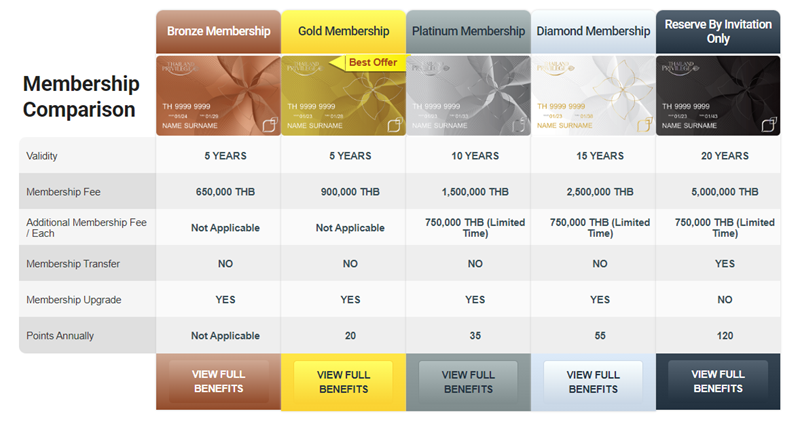
The Thailand Privilege Card program is open to individuals and families on a 5, 10, or 15-year basis, with different membership packages to suit various budgets and preferences. Memberships start with the “Bronze” option (special promo through September 30, 2026) for 650,000 THB—this gets you a 5-year visa for one person. At the top end, the “Diamond” membership runs 2,500,000 THB for a solo 15-year visa and a long list of luxury perks. Other membership levels fall in between, each with its own set of benefits. See the chart below to compare options and pick what fits you best.
Most people get their initial Non-Immigrant (O) Visa outside Thailand—you’ll usually have to leave the country to secure one before coming back in. It’s sometimes possible to convert another visa to a Non-Immigrant (O) inside Thailand, but that’s rare, totally up to Immigration, and never guaranteed. The main draw here? Unlike other dependent visas, the Non-Immigrant (O) Marriage Visa lets you apply for a Thai Work Permit without switching over to a Business Visa (B). That detail alone makes it a favorite. Employers love it too—the costs drop. Companies only need to show 1,000,000 THB in paid-up capital instead of the normal 2,000,000 THB, and the Thai staff ratio falls to two Thais per foreign hire instead of four. You’re not tied to an employer either. If you leave your job, you just cancel your Work Permit and can remain in Thailand while you look for new work, since your legal stay is based on your marriage.
To qualify, you’ll need to show 400,000 THB or more in a Thai bank account, or evidence of a recurring income of at least 40,000 THB per month—this could be salary, pension, dividends, or rental income from inside or outside Thailand, as long as it’s well documented and traceable. Along with finances, you need an official Thai marriage or birth certificate, plus a passport valid for 6 to 12 months, with a couple of blank pages. Grab a recent photo, proof of your current address, and bank statements or income documents too. Once approved, you have to keep up with Immigration’s 90 Day reporting rule.
Switch over to the Business Visa (B). Here, you must have a job with a Thai-registered company and hold a valid Thai Work Permit; otherwise, you’re out of compliance. This visa usually starts out as a 90-day Non-Immigrant B, issued by a Thai embassy or consulate outside the country. With ongoing employment and proper tax and immigration compliance, you can extend it up to a year at a Thai immigration office. Most applicants go through the official e-Visa portal or apply in person, depending on where they’re based.
What’s different from the Marriage Visa? Business Visas are locked to your job—your legal stay is totally tied to your work and company. Quit or lose your job, and your visa is canceled the same day. Unless you find a new sponsor immediately, you must leave Thailand. For a non-BOI Thai company to hire one foreigner, it needs at least 2,000,000 THB in registered capital and must employ at least four full-time Thai staff per foreign worker. The company must also keep up with taxes and Social Security payments. Regulations shift a bit if your company is BOI-promoted—those firms enjoy relaxed rules, quick processing, and staffing exemptions.
For a Business Visa, the job and company details on your Thai Work Permit have to match what you’re actually doing. Changing employers or roles requires full amendments to all your documents. Minimum salary thresholds (25,000–50,000 THB/month, depending on your nationality) must be met, and non-BOI visa holders need a doctor’s certificate confirming they’re free from specific diseases. Your passport should run 6 to 18 months beyond your planned stay, and you must always have at least one or two blank pages. Ongoing Immigration requirements, like 90 Day reporting, still apply.
The Destination Thailand Visa (DTV Visa) is new—good news for digital nomads, freelancers, or anyone involved in soft power activities like Muay Thai, cooking classes, music festivals, or even long-term medical treatments. DTV lets you stay up to 180 days per entry, with a one-time extension for another 180 days at a local immigration office (costs 1,900 THB) for a max of 360 days before you have to exit. To qualify, just show 500,000 THB (or equivalent in another currency) in a bank account, plus supporting documents like a remote work contract, a freelance portfolio, or an enrollment confirmation for your chosen activity. Applications go through the e-Visa portal or a consulate outside Thailand.
But don’t mistake the DTV for a traditional Non-Immigrant Visa—the law treats it as a long-stay tourist visa, not a work visa. Opening a Thai bank account on a DTV is tough; most banks will decline you unless you have a residency stamp or valid work permit. And don’t plan on local employment with a Thai business, as that isn’t allowed. Your passport needs to be undamaged, 6–12 months from expiry, with a couple of blank pages. Expect regular 90 Day reporting here too.
Now, the SMART Visa. Designed by the BOI and the Thai government, it targets high-skilled talent, tech entrepreneurs, investors, and executives—basically anyone working in Thailand’s “S-Curve” innovation sectors. You apply through the e-Visa portal for a BOI endorsement, which is required before you can pick up your visa. There are five main SMART Visa categories: T (tech/science talents earning 100,000 THB/month), I (individual investors, 5–20 million THB), E (executives with a 200,000 THB/month salary and 10+ years’ experience), S (startup founders with at least a 25% stake and 600,000 THB savings), and O (family/spouse/dependents).
The perks? No need for a separate Thai Work Permit—the SMART Visa sticker acts as your work authorization. 90 Day reporting only happens once a year. There’s a re-entry permit built in, so you can come and go without worrying about extra stamps. The program also lets spouses live and work in Thailand without needing their own work permit, as long as the job isn’t a protected profession. Depending on the category, the SMART Visa is valid up to four years (two for startup entrepreneurs) and can be renewed. To stay compliant, you need to file annual self-assessment reports with the BOI’s Smart Visa office. As always, keep your passport valid for the whole visa term (24–48 months), make sure it’s pristine, and bring along a medical certificate to clear you of the usual banned diseases.
Extended Long Term Visa Options (5 Years or More)
The Retirement Visa (O-X) is designed for foreigners over 50. Apply from your home country or permanent residence via the e-Visa portal or at a Thai embassy/consulate. You need a passport with at least 18 months’ validity and two to three blank pages. Financially, you’ll need a fixed deposit of at least 3,000,000 THB in Thailand, or at least 1,800,000 THB in the bank plus annual income of 1,200,000 THB—documented, of course. You must also show a police clearance from your country and a clean bill of health from a doctor, dated within the last three months. There’s one more requirement: health insurance that covers at least 40,000 THB outpatient and 400,000 THB inpatient treatment. If approved, you get a multiple-entry visa good for 10 years (issued for 5 years at first, with a 5-year extension). Note: you can’t work under this visa, and you’re still subject to Immigration’s 90 Day reporting.
Before you even enter Thailand, every foreigner must now submit a Thailand Digital Arrival Card (TDAC) online at tdac.immigration.go.th at least three days before arrival. This replaces the old paper TM6 form and is required no matter your visa type.
If you’re planning to travel in and out of Thailand, always get a single- or multiple-entry permit from Thai Immigration before you leave. Otherwise, you risk losing your Non-Immigrant Visa and being downgraded to a Tourist Visa on Arrival when you come back. Don’t forget.
Thailand Privilege (Elite) Visa Programs (5, 10 & 15 Years)
The Thailand Privilege Card program is open to individuals and families on a 5, 10, or 15-year basis, with different membership packages to suit various budgets and preferences. Memberships start with the “Bronze” option (special promo through September 30, 2026) for 650,000 THB—this gets you a 5-year visa for one person. At the top end, the “Diamond” membership runs 2,500,000 THB for a solo 15-year visa and a long list of luxury perks. Other membership levels fall in between, each with its own set of benefits. See the chart below to compare options and pick what fits you best. Thailand Privilege membership gives you a long list of perks, not just the basics. Here’s what you get:
1. No annual membership fees—just a one-time upfront payment, which depends on whether you pick Bronze, Gold, Platinum, or Diamond.
2. Unlimited help from an Elite Personal Assistant. They’ll greet you at the airport, both when you arrive and when you leave the country.
3. Unlimited use of the Premium Lane at Suvarnabhumi, Chiang Mai, and Phuket airports. You breeze through immigration and skip the lines.
4. Unlimited buy-one-get-one-free movie tickets at participating theaters.
5. An Elite Personal Liaison to help with banking, driving licenses, and government paperwork, available through the Privilege Point redemption system.
6. Special promo deals like “Buy 1 Get 1 Free” at places such as Mos Burger (with some conditions).
7. Buy-one-get-one or buy-two-get-one-free nights at select hotels, using your Privilege Points.
8. Access to airport transfers, airport lounges, private jets, limousines, car rentals, and yacht or boat rentals—again via Privilege Points.
9. Deals and access at movie theaters, restaurants, co-working spaces, shops, and networking events, all tied to your Privilege Points.
10. Access to golf courses, spas, annual health or dental check-ups, and fitness centers at partner venues, redeemable with points.
11. Insurance options and wealth management seminars through participating venues, again using points.
12. 90-day reporting service, making your visa requirements much easier to handle.
So, how do you sign up? The process is straightforward. You can apply for a Thailand Privilege Card, whether you’re already in Thailand or still overseas. Just contact My Pattaya Real Estate Co., Ltd.—they’ll connect you with a certified Thailand Privilege Visa specialist.
You need to pay the member rate—which depends on your chosen tier—and fill out an application. They also require a clean criminal background check. If you’re outside Thailand, you’ll get your Thailand Privilege Visa on arrival. If you’re in the country, you can collect it from the main Immigration Bureau in Bangkok, as long as your current visa allows. Make sure your passport is undamaged, has at least 12 months left, and at least one or two blank pages for the stamps.
Now, about the Long Term Resident (LTR) Visa. This visa’s good for ten years, and you can renew it, but don’t let the “Resident” part fool you. It doesn’t grant Thai residency or citizenship—just permits you to stay long-term under certain categories.
Here’s who might be eligible:
1. Wealthy Global Citizens: You have over $1 million in personal assets, or at least $80,000 a year in income, or $500,000 invested in Thai government bonds, foreign direct investment, or Thai property.
2. Wealthy Pensioners: You earn at least $80,000 a year, or at least $40,000 plus $250,000 invested in Thai government bonds, foreign investment, or property.
3. Foreign Remote Workers: You earn $80,000 a year, or at least $40,000 plus a Master’s degree (or higher), intellectual property rights, or Series A funding. You need at least five years of relevant experience and must work for a foreign company (public or private) with combined revenue over $150 million in the last three years.
4. Highly-Skilled Foreign Professionals: You earn at least $40,000 a year (for the last two years), plus a Master’s degree in science, technology, or have specialized skills for a job in Thailand. There are exclusions for those with a PhD or if you work for the Thai government—but generally you need five years of experience, unless you’ve got a doctorate.
No matter the category, you must have at least $50,000 in health insurance, or be self-insured with at least $100,000 in a Thai bank account. Your passport must be undamaged, with at least 12–18 months’ validity, and a couple of blank pages.
If you land an LTR Visa, here’s what you actually get:
1. A 10-year renewable visa, so no yearly renewals. That’s a lot less bureaucracy.
2. A digital work permit, letting you legally work in Thailand.
3. Exemption from the usual 4:1 Thai-to-foreigner employment ratio to get a work permit.
4. A 17% personal income tax rate, which is much lower than usual.
5. Priority access at immigration in major Thai international airports.
6. No more 90-day reporting—just check in once a year.
7. No need for re-entry permits each time you leave and return.
8. You can bring your spouse and children (under 20) as dependents, up to four people in total.
If you want to live, work, or invest in Thailand for the long haul, these programs make it easier and a lot more comfortable.
FAQ:
Most people get their initial Non-Immigrant (O) Visa outside Thailand—you’ll usually have to leave the country to secure one before coming back in. It’s sometimes possible to convert another visa to a Non-Immigrant (O) inside Thailand, but that’s rare, totally up to Immigration, and never guaranteed. The main draw here? Unlike other dependent visas, the Non-Immigrant (O) Marriage Visa lets you apply for a Thai Work Permit without switching over to a Business Visa (B). That detail alone makes it a favorite. Employers love it too—the costs drop. Companies only need to show 1,000,000 THB in paid-up capital instead of the normal 2,000,000 THB, and the Thai staff ratio falls to two Thais per foreign hire instead of four. You’re not tied to an employer either. If you leave your job, you just cancel your Work Permit and can remain in Thailand while you look for new work, since your legal stay is based on your marriage.
To qualify, you’ll need to show 400,000 THB or more in a Thai bank account, or evidence of a recurring income of at least 40,000 THB per month—this could be salary, pension, dividends, or rental income from inside or outside Thailand, as long as it’s well documented and traceable. Along with finances, you need an official Thai marriage or birth certificate, plus a passport valid for 6 to 12 months, with a couple of blank pages. Grab a recent photo, proof of your current address, and bank statements or income documents too. Once approved, you have to keep up with Immigration’s 90 Day reporting rule.
Switch over to the Business Visa (B). Here, you must have a job with a Thai-registered company and hold a valid Thai Work Permit; otherwise, you’re out of compliance. This visa usually starts as a 90-day Non-Immigrant B, issued by a Thai embassy or consulate outside the country. With ongoing employment and proper tax and immigration compliance, you can extend it up to a year at a Thai immigration office. Most applicants go through the official e-Visa portal or apply in person, depending on where they’re based.
What’s different from the Marriage Visa? Business Visas are locked to your job—your legal stay is totally tied to your work and company. Quit or lose your job, and your visa is canceled the same day. Unless you find a new sponsor immediately, you must leave Thailand. For a non-BOI Thai company to hire one foreigner, it needs at least 2,000,000 THB in registered capital and must employ at least four full-time Thai staff per foreign worker. The company must also keep up with taxes and Social Security payments. Regulations shift a bit if your company is BOI-promoted—those firms enjoy relaxed rules, quick processing, and staffing exemptions.
For a Business Visa, the job and company details on your Thai Work Permit have to match what you’re actually doing. Changing employers or roles requires full amendments to all your documents. Minimum salary thresholds (25,000–50,000 THB/month, depending on your nationality) must be met, and non-BOI visa holders need a doctor’s certificate confirming they’re free from specific diseases. Your passport should run 6 to 18 months beyond your planned stay, and you must always have at least one or two blank pages. Ongoing Immigration requirements, like 90 Day reporting, still apply.
The Destination Thailand Visa (DTV Visa) is new—good news for digital nomads, freelancers, or anyone involved in soft power activities like Muay Thai, cooking classes, music festivals, or even long-term medical treatments. DTV lets you stay up to 180 days per entry, with a one-time extension for another 180 days at a local immigration office (costs 1,900 THB) for a max of 360 days before you have to exit. To qualify, just show 500,000 THB (or equivalent in another currency) in a bank account, plus supporting documents like a remote work contract, a freelance portfolio, or an enrollment confirmation for your chosen activity. Applications go through the e-Visa portal or a consulate outside Thailand.
But don’t mistake the DTV for a traditional Non-Immigrant Visa—the law treats it as a long-stay tourist visa, not a work visa. Opening a Thai bank account on a DTV is tough; most banks will decline you unless you have a residency stamp or valid work permit. And don’t plan on local employment with a Thai business, as that isn’t allowed. Your passport needs to be undamaged, 6–12 months from expiry, with a couple of blank pages. Expect regular 90 Day reporting here too.
Now, the SMART Visa. Designed by the BOI and the Thai government, it targets high-skilled talent, tech entrepreneurs, investors, and executives—basically anyone working in Thailand’s “S-Curve” innovation sectors. You apply through the e-Visa portal for a BOI endorsement, which is required before you can pick up your visa. There are five main SMART Visa categories: T (tech/science talents earning 100,000 THB/month), I (individual investors, 5–20 million THB), E (executives with a 200,000 THB/month salary and 10+ years’ experience), S (startup founders with at least a 25% stake and 600,000 THB savings), and O (family/spouse/dependents).
The perks? No need for a separate Thai Work Permit—the SMART Visa sticker acts as your work authorization. 90 Day reporting only happens once a year. There’s a re-entry permit built in, so you can come and go without worrying about extra stamps. The program also lets spouses live and work in Thailand without needing their own work permit, as long as the job isn’t a protected profession. Depending on the category, the SMART Visa is valid up to four years (two for startup entrepreneurs) and can be renewed. To stay compliant, you need to file annual self-assessment reports with the BOI’s Smart Visa office. As always, keep your passport valid for the whole visa term (24–48 months), make sure it’s pristine, and bring along a medical certificate to clear you of the usual banned diseases.
Extended Long Term Visa Options (5 Years or More)
The Retirement Visa (O-X) is designed for foreigners over 50. Apply from your home country or permanent residence via the e-Visa portal or at a Thai embassy/consulate. You need a passport with at least 18 months’ validity and two to three blank pages. Financially, you’ll need a fixed deposit of at least 3,000,000 THB in Thailand, or at least 1,800,000 THB in the bank plus annual income of 1,200,000 THB—documented, of course. You must also show a police clearance from your country and a clean bill of health from a doctor, dated within the last three months. There’s one more requirement: health insurance that covers at least 40,000 THB outpatient and 400,000 THB inpatient treatment. If approved, you get a multiple-entry visa good for 10 years (issued for 5 years at first, with a 5-year extension). Note: you can’t work under this visa, and you’re still subject to Immigration’s 90 Day reporting.
Before you even enter Thailand, every foreigner must now submit a Thailand Digital Arrival Card (TDAC) online at tdac.immigration.go.th at least three days before arrival. This replaces the old paper TM6 form and is required no matter your visa type.
If you’re planning to travel in and out of Thailand, always get a single- or multiple-entry permit from Thai Immigration before you leave. Otherwise, you risk losing your Non-Immigrant Visa and being downgraded to a Tourist Visa on Arrival when you come back. Don’t forget.\
Thailand Privilege (Elite) Visa Programs (5, 10 & 15 Years)
The Thailand Privilege Card program is open to individuals and families on a 5, 10, or 15-year basis, with different membership packages to suit various budgets and preferences. Memberships start with the “Bronze” option (special promo through September 30, 2026) for 650,000 THB—this gets you a 5-year visa for one person. At the top end, the “Diamond” membership runs 2,500,000 THB for a solo 15-year visa and a long list of luxury perks. Other membership levels fall in between, each with its own set of benefits. See the chart below to compare options and pick what fits you best. Thailand Privilege membership gives you a long list of perks, not just the basics. Here’s what you get:
1. No annual membership fees—just a one-time upfront payment, which depends on whether you pick Bronze, Gold, Platinum, or Diamond.
2. Unlimited help from an Elite Personal Assistant. They’ll greet you at the airport, both when you arrive and when you leave the country.
3. Unlimited use of the Premium Lane at Suvarnabhumi, Chiang Mai, and Phuket airports. You breeze through immigration and skip the lines.
4. Unlimited buy-one-get-one-free movie tickets at participating theaters.
5. An Elite Personal Liaison to help with banking, driving licenses, and government paperwork, available through the Privilege Point redemption system.
6. Special promo deals like “Buy 1 Get 1 Free” at places such as Mos Burger (with some conditions).
7. Buy-one-get-one or buy-two-get-one-free nights at select hotels, using your Privilege Points.
8. Access to airport transfers, airport lounges, private jets, limousines, car rentals, and yacht or boat rentals—again via Privilege Points.
9. Deals and access at movie theaters, restaurants, co-working spaces, shops, and networking events, all tied to your Privilege Points.
10. Access to golf courses, spas, annual health or dental check-ups, and fitness centers at partner venues, redeemable with points.
11. Insurance options and wealth management seminars through participating venues, again using points.
12. 90-day reporting service, making your visa requirements much easier to handle.
So, how do you sign up? The process is straightforward. You can apply for a Thailand Privilege Card, whether you’re already in Thailand or still overseas. Just contact My Pattaya Real Estate Co., Ltd.—they’ll connect you with a certified Thailand Privilege Visa specialist.
You need to pay the member rate—which depends on your chosen tier—and fill out an application. They also require a clean criminal background check. If you’re outside Thailand, you’ll get your Thailand Privilege Visa on arrival. If you’re in the country, you can collect it from the main Immigration Bureau in Bangkok, as long as your current visa allows. Make sure your passport is undamaged, has at least 12 months left, and at least one or two blank pages for the stamps.
Now, about the Long Term Resident (LTR) Visa. This visa’s good for ten years, and you can renew it, but don’t let the “Resident” part fool you. It doesn’t grant Thai residency or citizenship—just permits you to stay long-term under certain categories.
Here’s who might be eligible:
1. Wealthy Global Citizens: You have over $1 million in personal assets, or at least $80,000 a year in income, or $500,000 invested in Thai government bonds, foreign direct investment, or Thai property.
2. Wealthy Pensioners: You earn at least $80,000 a year, or at least $40,000 plus $250,000 invested in Thai government bonds, foreign investment, or property.
3. Foreign Remote Workers: You earn $80,000 a year, or at least $40,000 plus a Master’s degree (or higher), intellectual property rights, or Series A funding. You need at least five years of relevant experience and must work for a foreign company (public or private) with combined revenue over $150 million in the last three years.
4. Highly-Skilled Foreign Professionals: You earn at least $40,000 a year (for the last two years), plus a Master’s degree in science, technology, or have specialized skills for a job in Thailand. There are exclusions for those with a PhD or if you work for the Thai government—but generally you need five years of experience, unless you’ve got a doctorate.
No matter the category, you must have at least $50,000 in health insurance, or be self-insured with at least $100,000 in a Thai bank account. Your passport must be undamaged, with at least 12–18 months’ validity, and a couple of blank pages.
If you land an LTR Visa, here’s what you actually get:
1. A 10-year renewable visa, so no yearly renewals. That’s a lot less bureaucracy.
2. A digital work permit, letting you legally work in Thailand.
3. Exemption from the usual 4:1 Thai-to-foreigner employment ratio to get a work permit.
4. A 17% personal income tax rate, which is much lower than usual.
5. Priority access at immigration in major Thai international airports.
6. No more 90-day reporting—just check in once a year.
7. No need for re-entry permits each time you leave and return.
8. You can bring your spouse and children (under 20) as dependents, up to four people in total.
If you want to live, work, or invest in Thailand for the long haul, these programs make it easier and a lot more comfortable. Here are some of the questions we often hear about joining the Thailand Elite Visa program:
What is the Thailand Elite Visa?
The Thailand Privilege Card, or Thailand Elite Visa, is a straightforward multiple-entry visa program tailored for individuals and families who want to stay in Thailand long-term. You can pick visa options that last 5, 10, 15, or 20 years.
Are “Thailand Privilege” and “Thailand Elite” the same thing?
Yes—they’re the same program. Starting October 1, 2023, Thailand Elite changed its name to Thailand Privilege. The lineup of memberships, the logo, and the general branding shifted along with the name.
How long can I stay in Thailand with an Elite Visa?
This program lets you enjoy much longer stays than a regular tourist visa. Depending on which package you choose, your visa lasts anywhere from 5 to 20 years, and members often can stay up to a year (or renew their stay) without those constant visa runs most other long-term travelers dread.
What are the main benefits?
You can stay in Thailand for up to a year without leaving just to meet the usual visa requirements. The visa is valid for five years and allows multiple entries. You’ll also get access to the Elite Personal Liaison Service—an assistant can even handle your 90-day immigration reporting on your behalf.
Who is eligible?
Applicants must have a legal foreign passport and no criminal record, deportations, or overstay issues—both in Thailand and other countries. You can’t apply if you’ve ever been declared of unsound mind or legally incompetent.
Which is the cheapest Thailand Elite Visa option?
The Bronze Membership is the entry-level choice. It runs 650,000 Thai Baht for five years. It covers fundamental visa services but does not include Privilege Points.
What about more premium options?
The Gold Membership, at 900,000 Thai Baht, adds 20 Privilege Points yearly that you can redeem for extra perks. For 10-year stays, there’s the Platinum package at 1.5 million Baht with 35 points per year. Fifteen years? That’s the Diamond Membership—2.5 million Baht, 55 points. The most exclusive, the Reserve Membership, lets you stay 20 years for 5 million Baht and 120 annual Privilege Points. Reserve is invitation-only.
Can I still get the Bronze Membership if I apply before Dec. 31, 2026?
Yes. If you submit your application by December 31, 2026, you’ll lock in the Bronze option at 650,000 Baht—even if the approval comes weeks later.
How do I apply for the Thailand Elite Visa?
Pick your membership package, fill out the application form, and send in the required supporting documents. The program screens your application, and if approved, you’ll get an invoice. Pay the membership fee, and you’ll receive your membership details and visa.
Is there an additional application fee?
No. You just pay the one-time membership fee (from 650,000 Baht for Bronze up to 5 million Baht for Reserve) after your app is approved. There’s no separate processing fee.
What documents do I need?
Submit a copy of your passport’s main information page, a high-res scan of a valid photo ID, the filled-out application form, and a completed Personal Data Policy Form. You can send these by email or mail.
How do I pay for the membership?
Pay straight from your own bank account—if you need to pay from someone else’s, make sure your name appears in the transaction details. There’s escrow available if your home country’s daily transfer limit is too low.
Which bank account and currency are required?
You can use either a Thai Baht or foreign currency account—foreign currency accounts, though, aren’t available in every Thai bank or every branch.
Can I open a local bank account as a member?
Yes. Elite Visa members can open an account with Thai banks. Bring your Elite membership letter, membership card, and passport. Different banks have different lists of required documents and minimum balances—check our guide for the specifics.
Is there a minimum balance I need for the visa application itself?
No, the program doesn’t require you to show a bank statement to apply.
Can I work in Thailand with an Elite Visa?
No. An Elite Visa alone doesn’t make you eligible for a work permit. You’ll need a separate work permit to work legally.
Can I get a credit card in Thailand as a member?
Yes, members can apply for a credit card at Bangkok Bank. Bring your passport, membership card or letter, and open a fixed deposit account with at least 50,000 Baht.
I already have a tourist visa. Can I switch to an Elite Visa?
Yes, as long as you haven’t overstayed your current visa, you can upgrade to an Elite Visa.
Can I apply for the Elite Visa from inside Thailand?
Yes, you can apply whether you’re in Thailand or abroad.
Is health insurance required for the Thailand Elite Visa?
No, you’re not required to have health insurance or COVID insurance to join the program.
Please contact us for more information:
